

Travel Options and Routes from Nairobi to Serengeti
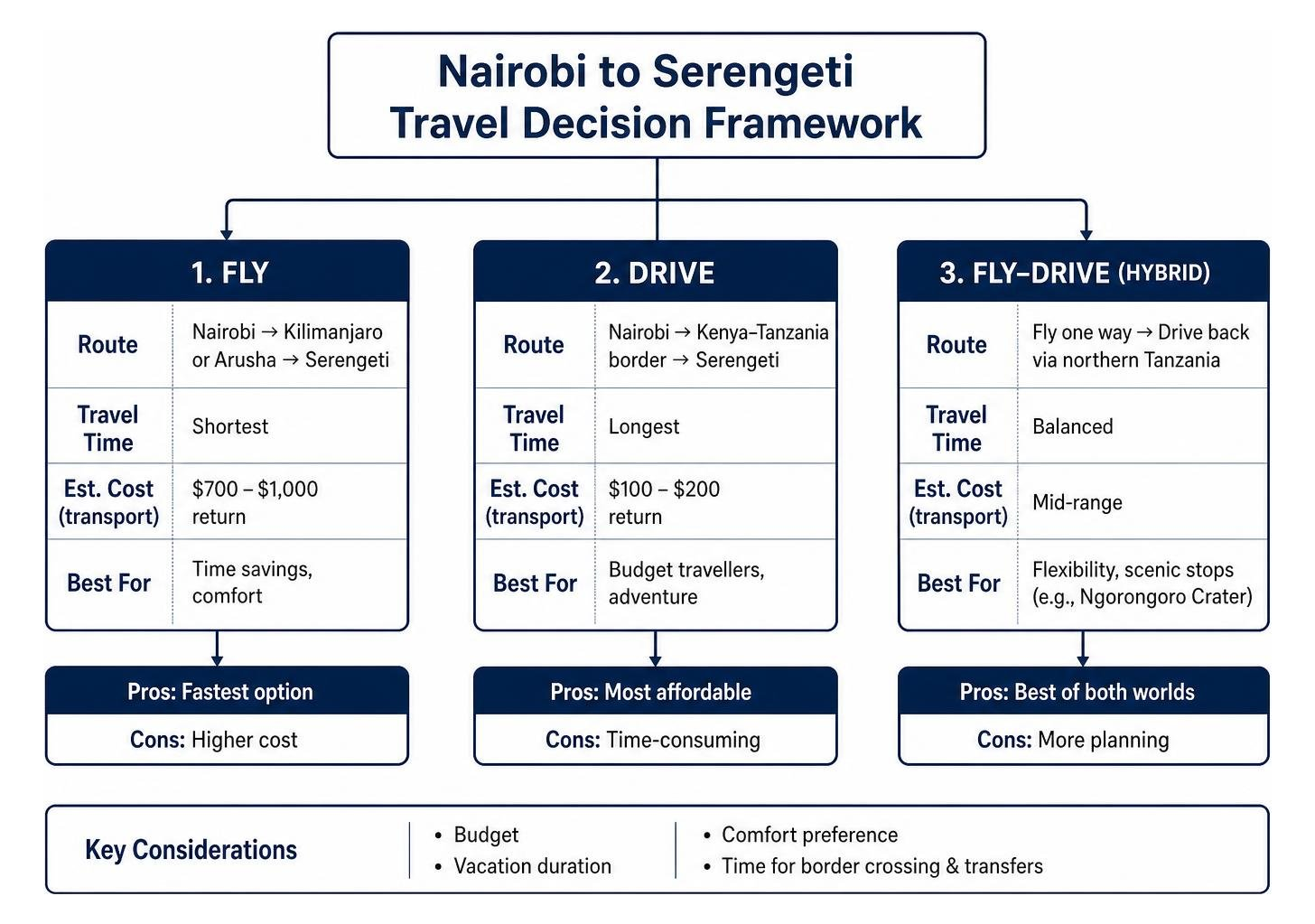
Travelling from nairobi to serengeti involves covering a road distance of roughly 700 to 800 kilometres across the Kenya-Tanzania border. If you choose to fly, the straight-line aerial distance drops to around 400 to 500 kilometres, though you will need to clear immigration at an official port of entry along the way.
Book Your Transfer
Fill in your details and we'll confirm your booking on WhatsApp.
Choosing between air and road travel depends on your budget, vacation duration, and personal comfort. A standard round-trip flight package connecting Nairobi to the Serengeti typically ranges from $700 to $1,000 per person for transport alone. In contrast, overland travel using shared shuttles or public transport costs significantly less, roughly $100 to $200 return, though it requires a much longer time commitment.
For many travellers, a fly-drive hybrid safari offers the best of both worlds. A combined route lets you fly one way to save time and drive back through northern Tanzania, allowing you to stop at iconic highlights like the Ngorongoro Crater without spending your entire itinerary on the road.
Flying Options for Nairobi to Serengeti
Flying is by far the fastest way to travel from nairobi to serengeti. Most regional safari flights depart from Nairobi’s Jomo Kenyatta International Airport (NBO) or Wilson Airport (WIL). Because there are no direct international commercial flights landing directly on dirt airstrips inside national parks, every flight route involves a connection where you clear cross-border customs and immigration.
The standard air route begins with a short 45-to-55-minute flight from Nairobi to Kilimanjaro International Airport (JRO) or Arusha Airport (ARK), costing between $150 and $300 one way. Once you clear passport control at Kilimanjaro or Arusha, you transfer to a domestic bush plane operated by regional bush airlines. This connecting flight into the park takes another 1 to 2 hours and costs between $200 and $400 one way.
When booking your air itinerary, ensure you align your choice of landing strip with your lodge location. The main airstrips servicing the park include:
- Seronera Airstrip (SEU): Located in Central Serengeti, this is the primary year-round hub for most safari lodges.
- Kogatende Airstrip: Located in Northern Serengeti, best utilized during the Great Migration river crossings from July to October.
- Ndutu Airstrip: Located in the Southern Serengeti/Ngorongoro border region, ideal for the wildebeest calving season between January and March.
- Grumeti Airstrip: Located in Western Serengeti, serving the western corridor and Grumeti River region.
Be mindful that domestic bush flights strictly enforce a luggage limit of 15 kilograms (33 lbs) per passenger, which must be packed inside soft-sided duffel bags to fit inside aircraft cargo holds.
Overland Driving Routes for Nairobi to Serengeti
If you prefer an overland road trip, driving from nairobi to serengeti takes approximately 10 to 14 hours depending on traffic, road conditions, and border processing delays. We strongly advise breaking this journey into a two-day trip with an overnight stop in Arusha or Karatu rather than attempting to drive it in a single day.
There are two primary overland routes to consider:
- The Namanga Route (Nairobi to Namanga to Arusha to Serengeti): This is the most common path for travellers undertaking a broader Northern Tanzania circuit. The drive from Nairobi to the Namanga border post takes about 3.5 hours on smooth paved highways. After completing border clearance (typically taking 45 to 90 minutes), you drive another 2 to 3 hours to Arusha. From Arusha, you travel through the Ngorongoro Conservation Area before reaching the Serengeti’s Naabi Hill Gate.
- The Isebania Route (Nairobi to Maasai Mara / Migori to Isebania to Serengeti): If you are combining a visit to the Maasai Mara with the Serengeti, the Isebania border crossing in the west is the most direct option. The drive from Nairobi to Isebania takes roughly 6 to 7 hours, followed by an additional 3 to 4-hour drive from the border into the Northern or Central Serengeti gates.
It is critical to know that cars with foreign (Kenyan) registration plates are legally prohibited from entering Tanzanian national parks. To navigate this rule overland, you must either book a guided tour where driver-guides arrange a vehicle swap at the border, hire a registered Tanzanian vehicle through professional Car Hire And Taxi Hire Services, or use shared cross-border shuttle services.
Border Crossing Requirements and Essential Travel Documents
Crossing from Kenya into Tanzania requires passing through border posts like Namanga or Isebania. To ensure a smooth transition through border control, double-check that you have all required travel documentation organized well in advance:
- Passport: Your passport must have at least 6 months of remaining validity from your entry date and contain at least two blank facing pages for immigration stamps.
- Tanzanian Visa: Most foreign nationals require a visa to enter Tanzania. Single-entry visas cost between $50 and $100 depending on your country of origin (US citizens pay $100 for a multiple-entry visa). Visas can be obtained online via the official Tanzanian e-visa portal or purchased on arrival at border stations using crisp USD cash printed after 2013.
- Yellow Fever Certificate: Under World Health Organization health regulations, proof of Yellow Fever vaccination is required when entering Tanzania from Kenya, as Kenya is classified as an endemic zone. The certificate becomes valid 10 days after receiving the shot.
- Vehicle Documentation: If you are crossing with a commercial vehicle, driver-guides must present valid cross-border permits, vehicle registration logs, international insurance certificates (COMESA card), and transport operator licences.
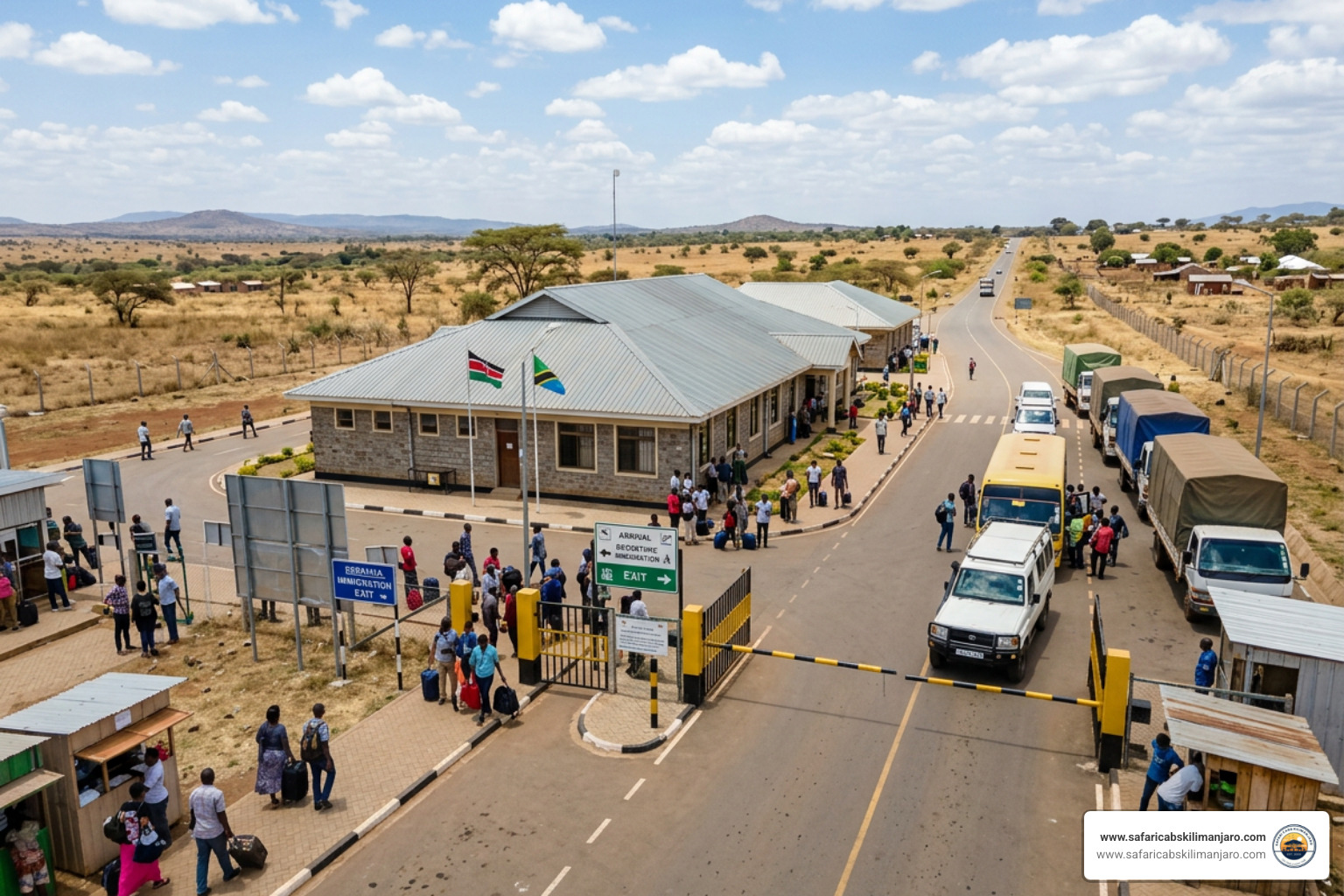
Both Namanga and Isebania operate as One-Stop Border Posts (OSBP), meaning you complete departure formalities for Kenya and entry procedures for Tanzania inside a single shared facility, minimizing border clearance time.
Serengeti Park Entrance Fees and Airstrip Guide
Entering Serengeti National Park requires paying daily conservation fees managed by the Tanzania National Parks Authority (TANAPA). Fees are charged on a strict 24-hour cycle from the moment you pass through an entry gate or land at a park airstrip.
Park entrance fees vary based on visitor category and age:
- Adult Foreign Visitors (16+ years): US$ 70.80 to US$ 82.60 per person per 24 hours (inclusive of 18% VAT), depending on low vs high tourist season.
- Children Foreign Visitors (5–15 years): US$ 23.60 per child per 24 hours (inclusive of VAT).
- Young Children (Under 5 years): Free entry.
Cash is strictly rejected at all TANAPA entry gates (such as Naabi Hill, Ndabaka, or Klein’s Gate). All payments must be made using a Visa card, Mastercard, or a pre-loaded TANAPA Smartcard arranged by your safari operator.
To help you evaluate travel options for your upcoming safari, review this cost and timeline comparison:
| Route Option | Transport Cost Range (Per Person) | Travel Duration | Key Advantages |
|---|---|---|---|
| Fly-In Safari (NBO/WIL to JRO/ARK to Park Airstrip) | $700 – $1,000 (Round Trip) | 4 – 6 hours total | Maximum wildlife time, ultimate comfort |
| Overland Drive (Nairobi to Border to Arusha to Park) | $100 – $200 (Shuttle/Public) | 10 – 14 hours | Budget-friendly, scenic road trip experience |
| Fly-Drive Combo (Fly in, Drive back via Ngorongoro) | $350 – $600 (One Way Flight + Road) | 2 – 3 days transit | Balanced pacing, includes Ngorongoro Crater |
Combining Maasai Mara and Serengeti Safaris
The Maasai Mara National Reserve in Kenya and the Serengeti National Park in Tanzania share a continuous, unfenced ecosystem separated only by the international political border. Over 1.5 million wildebeest, 200,000 zebras, and hundreds of thousands of gazelles migrate across this boundary every year during the Great Migration.

Despite their geographic proximity, you cannot drive directly across the border from inside the Maasai Mara to inside the Serengeti because the historical Bologonya Gate border point remains closed to tourist traffic. To combine both reserves into one seamless trip, consider these efficient travel strategies:
- The Air-Road-Air Bridge (Migori to Tarime): Fly from the Maasai Mara airstrip to Migori Airstrip near the Kenyan border. Take a short 30-minute vehicle transfer across the Isebania border to Tarime Airstrip on the Tanzanian side, then board a short domestic flight straight into your Serengeti lodge airstrip.
- Border Vehicle Swap: Drive from the Maasai Mara to the Isebania border, walk through immigration on foot, and meet a fresh Tanzanian vehicle and driver-guide on the opposite side.
- Extended Multi-Week Itinerary: Give yourself at least 10 to 14 days when combining both ecosystems. Rushing both parks into a short 5-day window leads to excessive transit fatigue rather than enjoyable wildlife viewing.
Here are a few quick tips when planning a combined Mara-Serengeti itinerary:
- Secure both Kenyan and Tanzanian e-visas online before arriving at the border.
- Carry printed copies of your Yellow Fever vaccination cards in your daypack.
- Ensure your luggage stays under the 15kg soft-bag limit for small bush planes.
- Schedule a 3-hour layover window when connecting between bush flights at regional hubs.
Frequently Asked Questions About Nairobi to Serengeti Travel
Can you drive from Nairobi to Serengeti in one day?
While it is physically possible to drive from Nairobi to the Serengeti in one day (a direct drive takes 10 to 14 hours depending on traffic and border delays), we strongly advise against it. Gates into the Serengeti strictly close at 6:00 PM daily, and driving on unpaved park roads after dark is dangerous and forbidden.
Attempting this drive in a single day leaves zero room for unexpected delays at border control or bad weather. Instead, break the overland trip into two manageable days by spending an overnight night in Arusha or Karatu before entering the park early the following morning.
What are the park entry fees for Serengeti National Park?
Serengeti entry fees are structured per 24-hour period. Non-East African adult visitors (16+ years old) pay US$ 70.80 per 24 hours during the low season and US$ 82.60 per 24 hours during the high season (July to March). Entrance for children aged 5 to 15 costs US$ 23.60 per 24 hours, while children under 5 enter for free.
All entrance fees are subject to 18% Tanzanian VAT, which is included in these figures. Park gates do not accept cash under any circumstances; payment must be processed electronically using Visa or Mastercard credit/debit cards.
What is the best time of year to visit the Serengeti from Nairobi?
The Serengeti provides world-class game viewing year-round, but the best time to visit depends on what wildlife spectacles you wish to witness:
- July to October (Dry Season): Ideal for witnessing the dramatic Great Migration river crossings across the Mara River in Northern Serengeti (Kogatende).
- January to March: Best for viewing the wildebeest calving season in the Southern Serengeti and Ndutu plains, where thousands of calves are born daily, attracting heavy predator action.
- June and July: Perfect for seeing the herds move through the Western Corridor and cross the Grumeti River.
- April and May (Long Rains): Offers low tourist crowds, lower lodge rates, and vibrant green scenery, though some roads can become muddy.
Conclusion
Planning your journey from nairobi to serengeti requires choosing the right travel style for your group, whether you fly to save time, drive overland to reduce costs, or combine both modes into a flexible itinerary. By understanding border requirements, arranging necessary travel documents, and choosing landing airstrips that align with seasonal wildlife movements, you can enjoy a smooth journey across East Africa.
If you are flying into Kilimanjaro International Airport (JRO) or stopping over in Arusha on your way to the park, our team at Safari Cabs Kilimanjaro provides reliable ground transport. Explore our guide on taking a safari from Kilimanjaro To Serengeti, or easily Book airport transfers via Kilimanjaro Airport to Arusha to ensure your cross-border safari starts without a hitch.