

Overview of Kilimanjaro International Airport (JRO)
Airport to Kilimanjaro
Book Your Transfer
Fill in your details and we'll confirm your booking on WhatsApp.
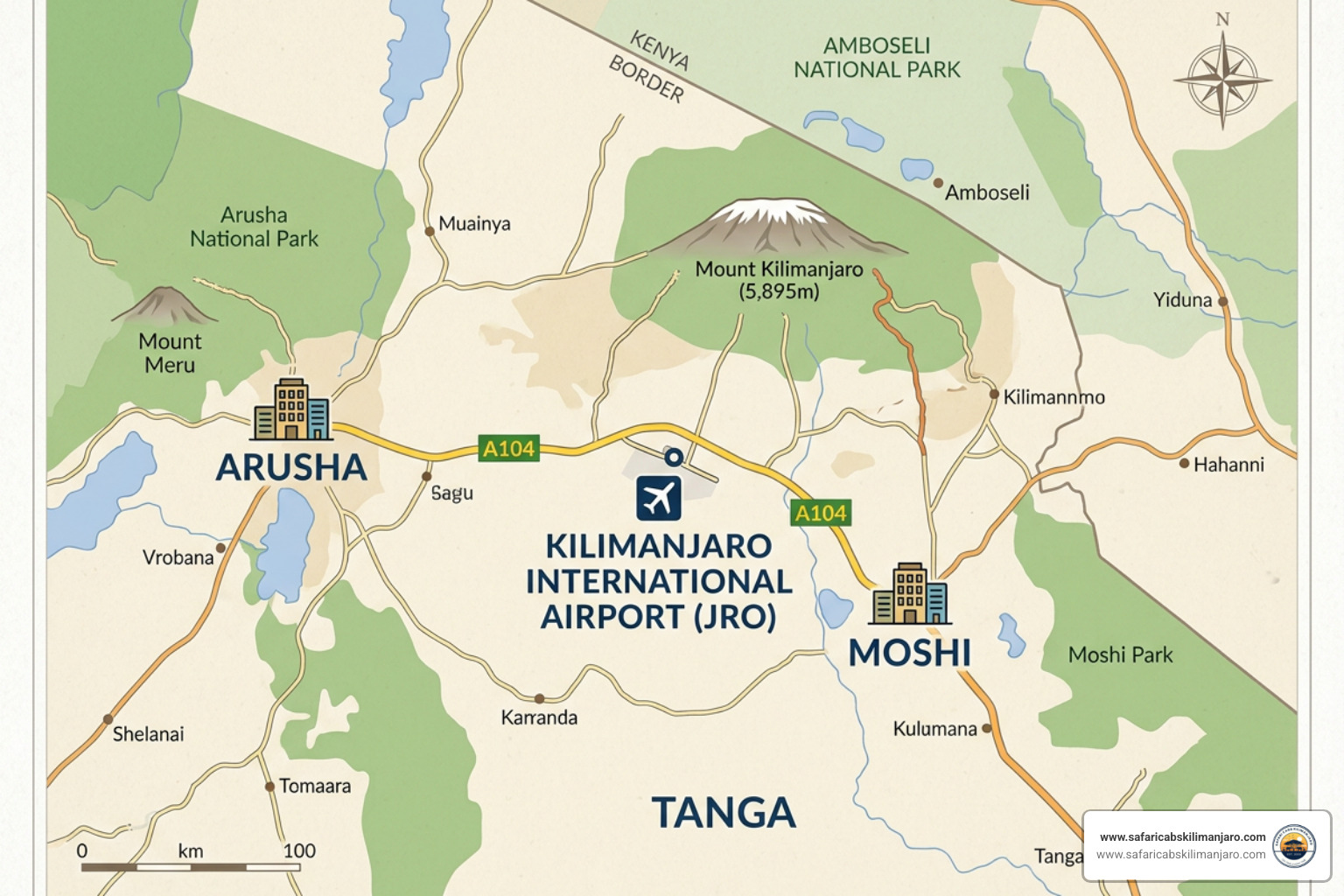
Kilimanjaro International Airport (IATA: JRO, ICAO: HTKJ) sits in the Hai District of the Kilimanjaro Region. It was deliberately built in 1971 roughly halfway between the two main hubs of northern Tanzania: the town of Moshi and the safari capital of Arusha. Positioned at an elevation of 2,932 feet (894 meters) above sea level, JRO serves as the main entry point for travelers visiting Mount Kilimanjaro National Park, Arusha National Park, Tarangire, Lake Manyara, the Ngorongoro Conservation Area, and the Serengeti.
In 2024, the airport reached a significant milestone by handling 1,044,276 passengers along with over 24,000 aircraft movements. This represents substantial growth from 2012 when it served 665,147 passengers, and 2014 when traffic reached 802,731 passengers (split across 45% international, 38% domestic, and 17% transit travelers). Despite handling over a million travelers annually, JRO maintains a simple, compact layout that makes navigating arrivals straightforward.
Key Distances and Durations to Moshi, Arusha, and Trekking Gates
Understanding the geographic layout of northern Tanzania helps you choose the right base for your itinerary:
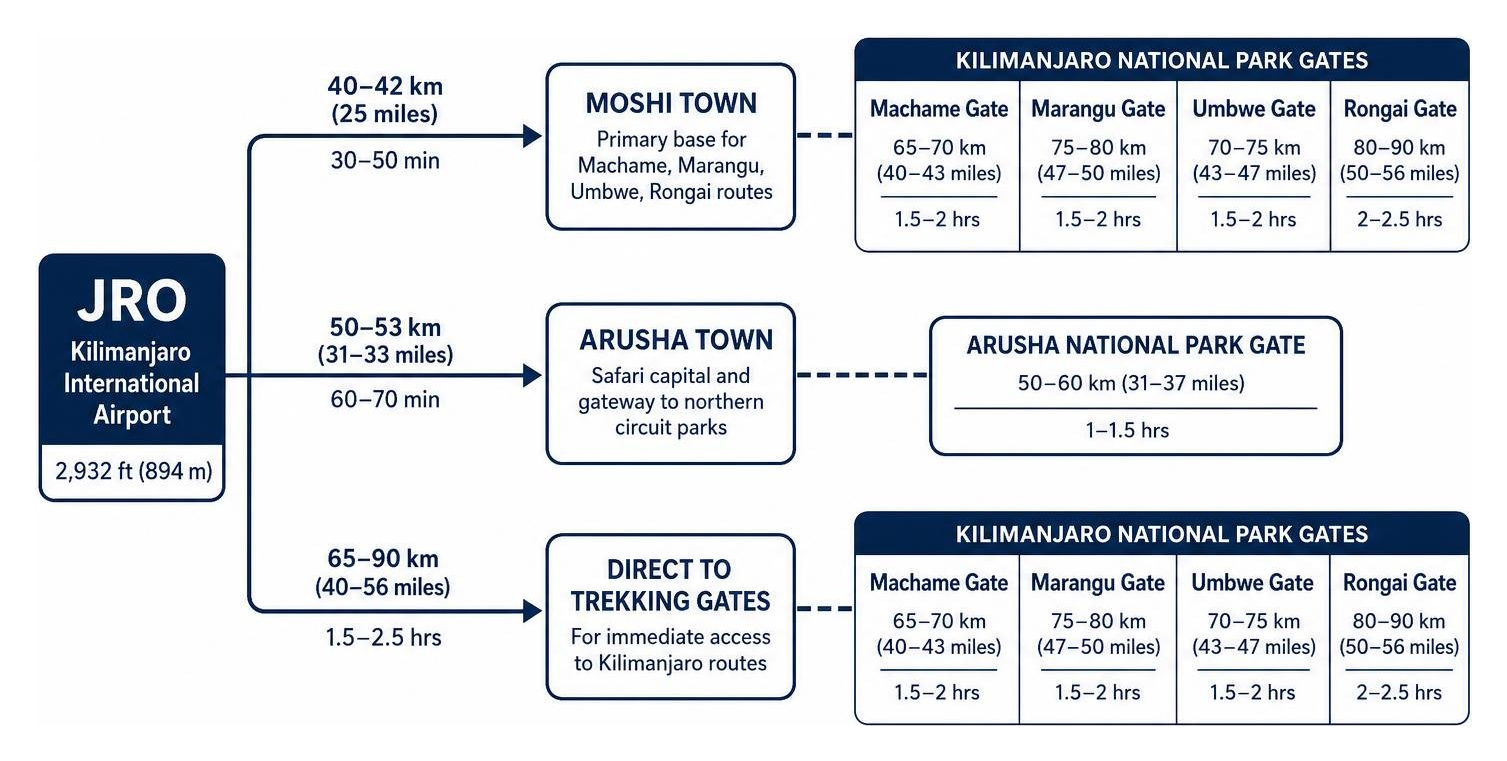
- JRO to Moshi Town: Moshi lies 40 to 42 km (25 miles) east of the airport. The drive along the smoothly paved A23 highway takes between 30 and 50 minutes under normal traffic conditions. Moshi is the primary staging ground for treks taking the Machame, Marangu, Umbwe, or Rongai routes.
- JRO to Arusha Town: Arusha sits 50 to 53 km (31 to 33 miles) west of JRO. The journey takes about 60 to 70 minutes. However, during morning (7:00 AM – 9:00 AM) or evening (4:30 PM – 6:30 PM) peak hours, entering Arusha can add 20 to 30 minutes to your travel time. For more detail on this specific route, check our guide on the Kilimanjaro Airport to Arusha Distance.
- JRO Directly to Trekking Gates: If your climbing itinerary requires immediate travel to the mountain gates, distances range from 65 to 90 km (40 to 56 miles), requiring 1.5 to 2.5 hours of road time depending on whether your entry gate is Machame, Marangu, or Londorossi.
JRO Airport History, Capacity, and Facilities
Built at an original construction cost of $13 million, JRO officially opened on December 2, 1971. In 1998, it made aviation history by becoming the first international airport in Africa to be privatized, initially managed by the Kilimanjaro Airport Development Company (KADCO). Today, it is owned by the Government of Tanzania and operated under the Tanzania Airports Authority (TAA).
Major infrastructure upgrades initiated in November 2015 modernized the terminal building, expanded the apron space, and upgraded navigation systems, effectively doubling terminal handling capacity to 1.2 million passengers per year. The airport features a single asphalt runway (09/27) measuring 11,811 feet (3,600 meters) in length. This expansive runway allows JRO to handle long-haul wide-body commercial aircraft such as Boeing 747s and heavy cargo carriers like the Antonov 124.
Inside the terminal building, basic passenger amenities include:
- ATMs: Located in the arrivals area, dispensing Tanzanian Shillings (TZS). Airport ATMs can occasionally run out of cash or experience network outages, so carrying USD cash reserves is vital.
- SIM Card Kiosks: Local mobile network providers (such as Vodacom and Airtel) operate counters outside the baggage claim area where you can purchase tourist SIM cards and data packages.
- Currency Exchange Counters: Available for converting major foreign currencies into TZS.
- Transit Lounge and Cafes: Basic food and beverage services are available before clearing security or while waiting for transfers.
Travel Options for Getting From the Airport to Kilimanjaro
Arranging reliable ground transport for your airport to kilimanjaro trip is essential after a long-haul flight. Ground transportation from JRO spans four primary choices: pre-booked private transfers, airport taxis, shared shuttle buses, and local public transport (daladalas).
| Transport Type | Estimated Cost (USD) | Travel Duration to Moshi | Travel Duration to Arusha | Key Advantages | Best Suited For |
|---|---|---|---|---|---|
| Pre-Booked Private Transfer | $40 – $80 per vehicle | 30 – 50 min | 60 – 70 min | Door-to-door, flight tracking, meet & greet, fixed price | Trekkers, families, groups, late arrivals |
| On-Arrival Airport Taxi | $45 – $60 per vehicle | 40 – 60 min | 60 – 80 min | Available on demand outside terminal | Unplanned travel, solo travelers with light luggage |
| Shared Shuttle Bus | $10 – $15 per person | 60 – 90 min | 90 – 120 min | Budget friendly | Solo budget travelers landing midday |
| Public Daladala Bus | ~$2 – $4 per person | 90+ min (multi-transfer) | 120+ min (multi-transfer) | Extremely cheap | Experienced backpackers with minimal gear |
Pre-Booked Private Transfers from the Airport to Kilimanjaro
Pre-booking a private driver is widely considered the safest and most efficient choice for international arrivals. When you schedule a ride in advance through Kilimanjaro Airport Transfers, your driver meets you directly inside the arrival terminal holding a personalized name board.
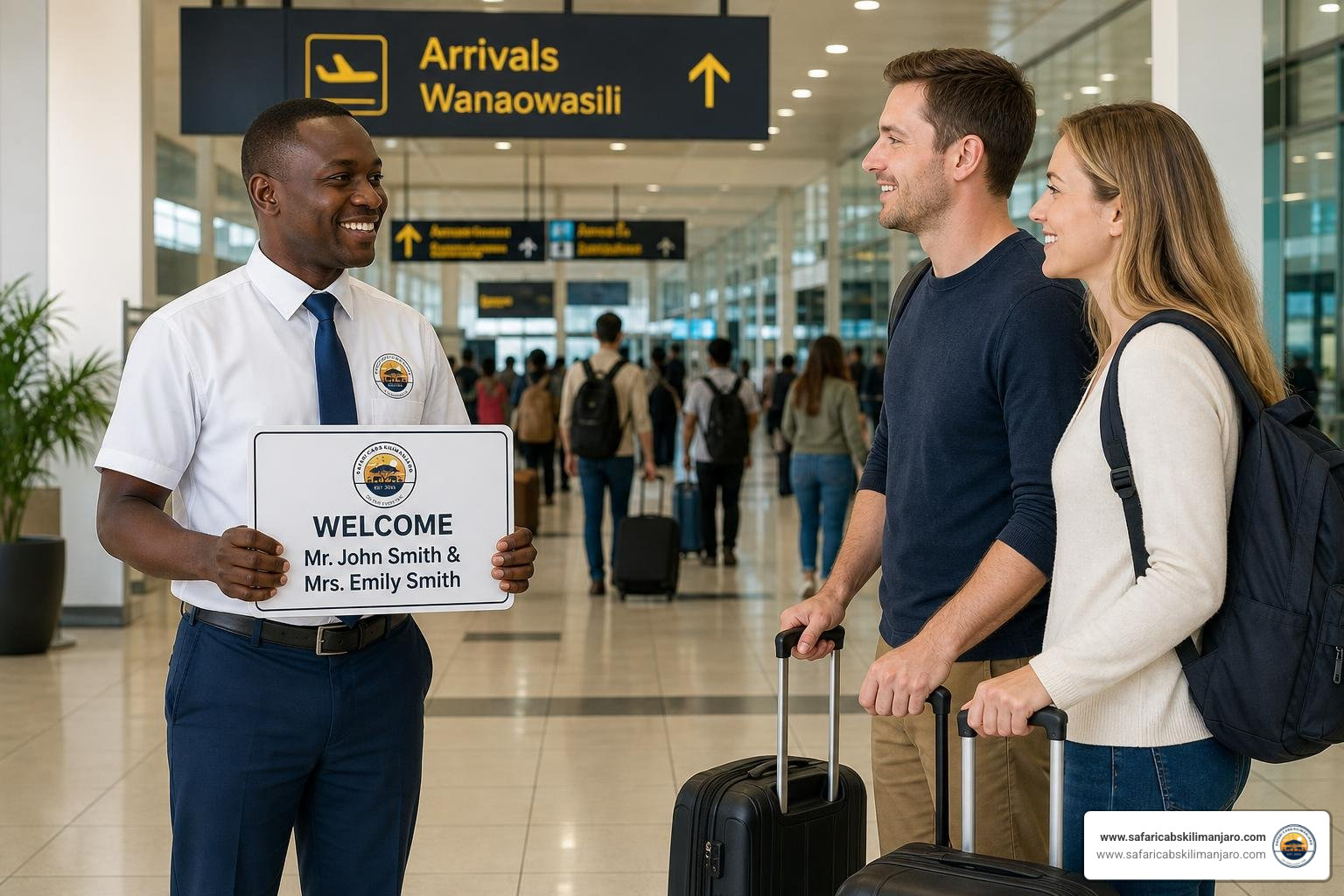
Key benefits of pre-booking a private vehicle include:
- Real-Time Flight Tracking: Drivers monitor your aircraft’s tail number. If your flight is delayed, your pickup time automatically adjusts without incurring penalties. Most private transfer services include 60 minutes of complimentary waiting time after your flight actually touches down.
- Door-to-Door Convenience: You are driven directly to your specific lodge, hotel, or private residence in Moshi or Arusha without unscheduled stops or transfer vehicle changes.
- Vehicle Sizing Flexibility: Depending on your group size and baggage volume, you can select from standard sedans (1–3 passengers), spacious minivans like a Toyota Alphard or HiAce (3–7 passengers), 4×4 safari Land Cruisers, or larger 20-to-40-seater safari buses for major expedition groups.
- Family Safety Amenities: Professional private transfer services can provide complimentary child safety seats upon request, which are not available in standard unbooked taxis.
Shared Shuttles, Taxis, and Regional Buses
If you choose not to pre-book, options are available outside the terminal exit, though they require extra vigilance:
- On-Arrival Airport Taxis: Officially licensed airport taxis park outside the main terminal entrance. Rides to Moshi typically range from $40 to $50 USD, while rides to Arusha run between $45 and $60 USD. Prices are frequently negotiated on the spot, so you must agree on the final fare before entering the vehicle. Cash in USD or TZS is required.
- Shared Shuttle Buses: Regional shuttle buses run fixed routes connecting JRO to central drop-off locations in Moshi and Arusha. Seats cost roughly 10,000 TZS to 35,000 TZS ($4 to $15 USD) per person. Shuttles generally operate on fixed departure times or wait until every seat is filled before departing, making them slower than private transfers. For detailed pricing structures across different routes, consult our guide on Kilimanjaro Airport to Moshi Cost.
- Public Daladalas: The cheapest transport option involves walking or taking a short taxi ride from the terminal out to the main A23 junction (Boma Ng’ombe), where local minibuses (daladalas) pass by. While a daladala ride costs less than $3 USD, these vehicles are tightly packed, lack dedicated luggage compartments, make frequent roadside stops, and are ill-suited for travelers carrying large duffel bags stuffed with high-altitude climbing equipment.
Flying to JRO: Airlines, Routes, and Budget Transit Strategies
Planning your air travel efficiently helps ensure you arrive well-rested for your climb or safari expedition.
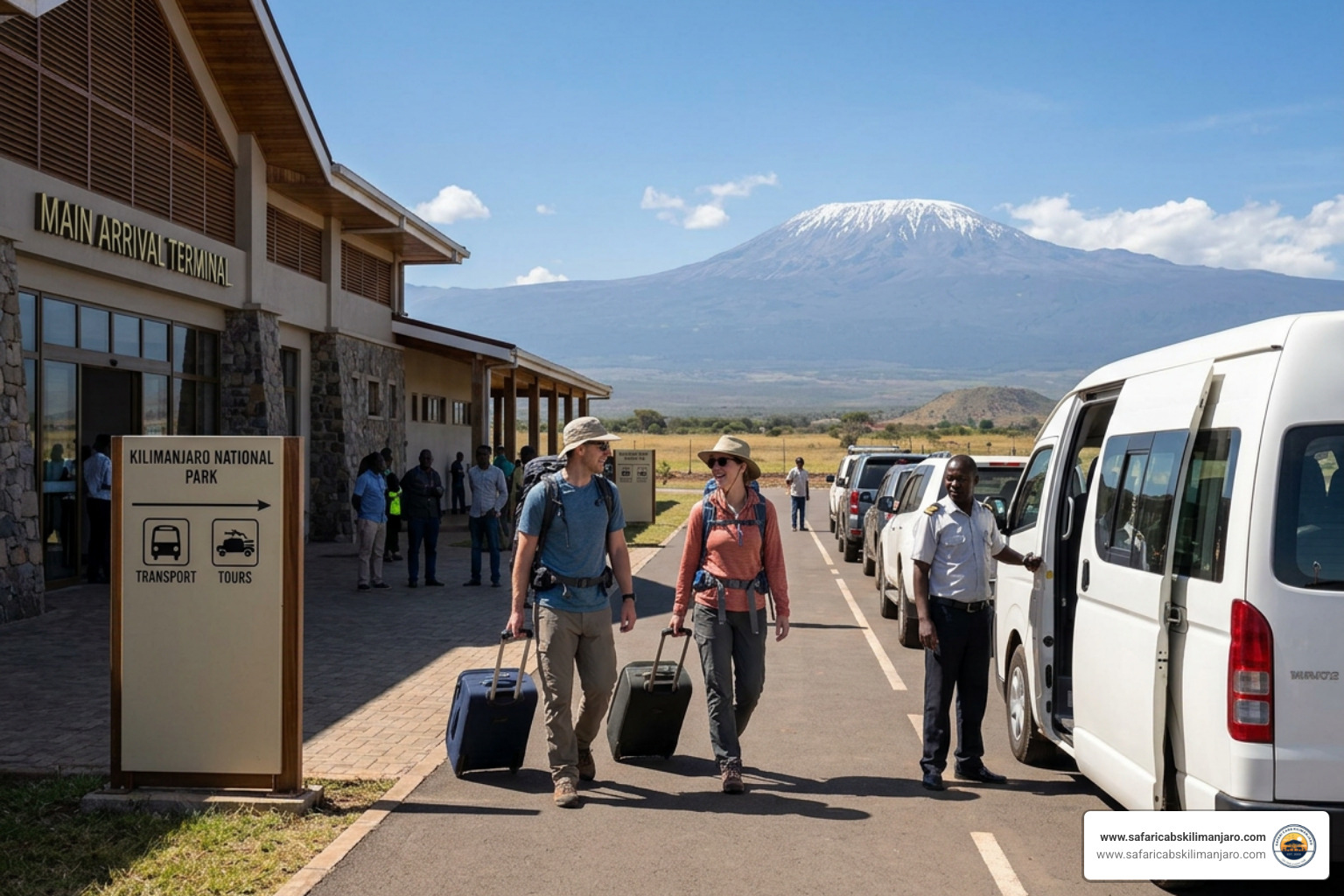
Major International Airlines and Connection Hubs
Several major international carriers offer direct long-haul flights or convenient single-stop connections into Kilimanjaro International Airport:
- KLM Royal Dutch Airlines: Operates daily flights from Amsterdam (AMS) directly to JRO. This is one of the most popular routes for European and North American travelers, providing seamless single-ticket connections.
- Ethiopian Airlines: Offers extensive global connections via its main hub in Addis Ababa (ADD), serving JRO daily.
- Qatar Airways: Connects through Hamad International Airport in Doha (DOH), offering convenient itineraries from North America, Europe, Australia, and Asia.
- Turkish Airlines: Flies into JRO via Istanbul (IST). Note: Many Turkish Airlines flights land late at night or during the early morning hours (between 1:00 AM and 4:00 AM).
- Kenya Airways: Operates frequent regional shuttle flights connecting Nairobi’s Jomo Kenyatta International Airport (NBO) to JRO.
Domestic carriers including Precision Air, Air Tanzania, Coastal Aviation, and Air Excel operate frequent regional flights connecting JRO with Dar es Salaam (DAR), Zanzibar (ZNZ), Seronera (Serengeti), and Entebbe (EBB).
Budget Routes via Nairobi and Dar es Salaam
If direct international airfares to JRO exceed your budget, alternative routing options can significantly reduce total transport costs:
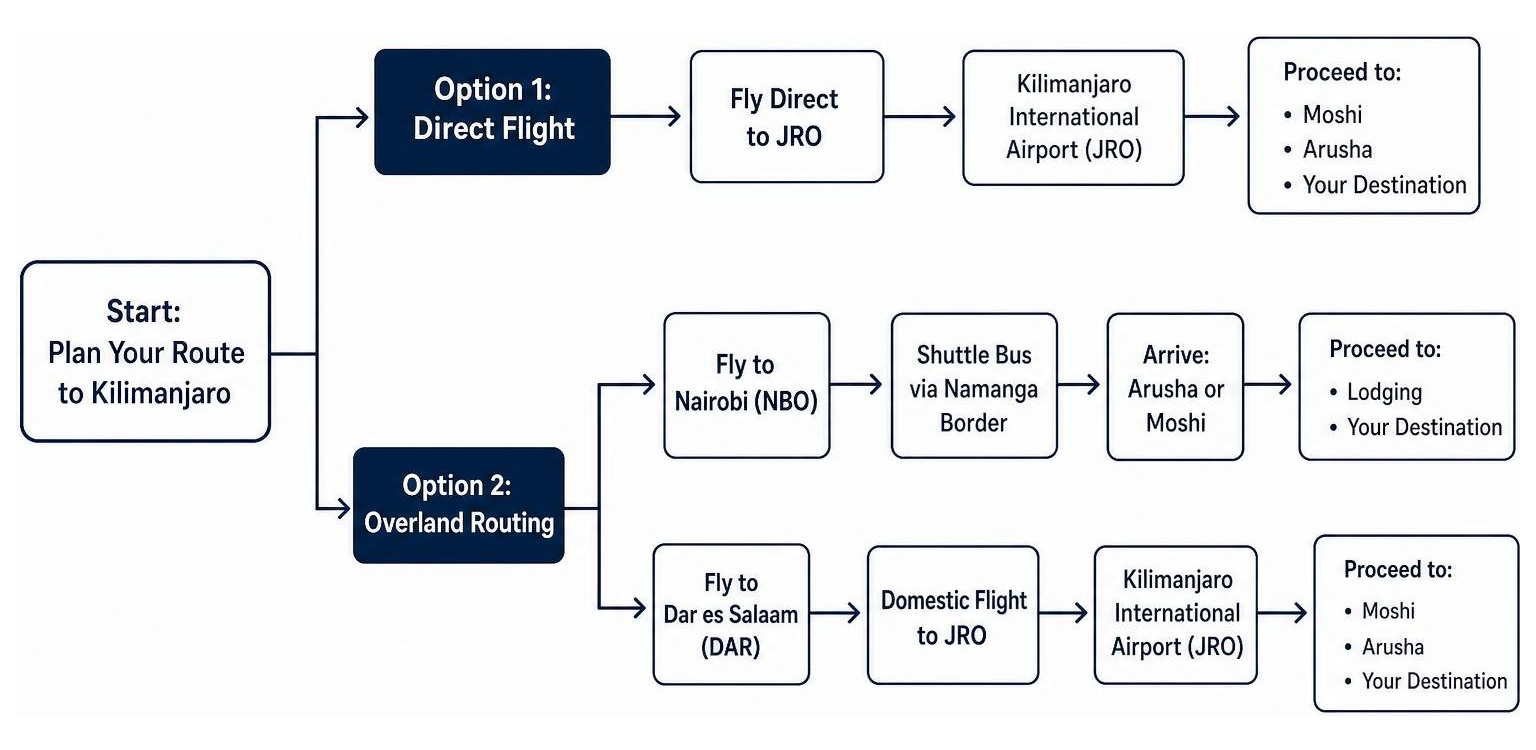
- The Nairobi Overland Route: Airfares flying into Nairobi (NBO) in neighboring Kenya are often hundreds of dollars cheaper than direct tickets into JRO. From Nairobi, you can take a daily regional shuttle bus across the Namanga border post to Arusha or Moshi. Shuttle bus tickets cost approximately $30 to $35 USD each way, covering the 320 km (200 mile) journey in 5 to 7 hours depending on border processing queues.
- Cost Considerations: When evaluating this budget route, factor in the cost of a Kenyan entry or transit visa (up to $50–$122 depending on nationality and visa type) plus potential Yellow Fever vaccination requirements for cross-border transit.
- The Dar es Salaam Domestic Connection: Another option is flying into Julius Nyerere International Airport (DAR) in Dar es Salaam, followed by a local domestic flight to JRO on Air Tanzania or Precision Air. Domestic flights between DAR and JRO cover roughly 595 km (370 miles) and take about 1 hour and 20 minutes, with fares starting around $60 to $120 USD.
JRO Arrival Essentials: Visas, Health Requirements, and Avoiding Scams
Navigating immigration and arrival logistics smoothly ensures a stress-free start to your Tanzanian adventure.
Navigating Visas, Yellow Fever Cards, and Airport Logistics
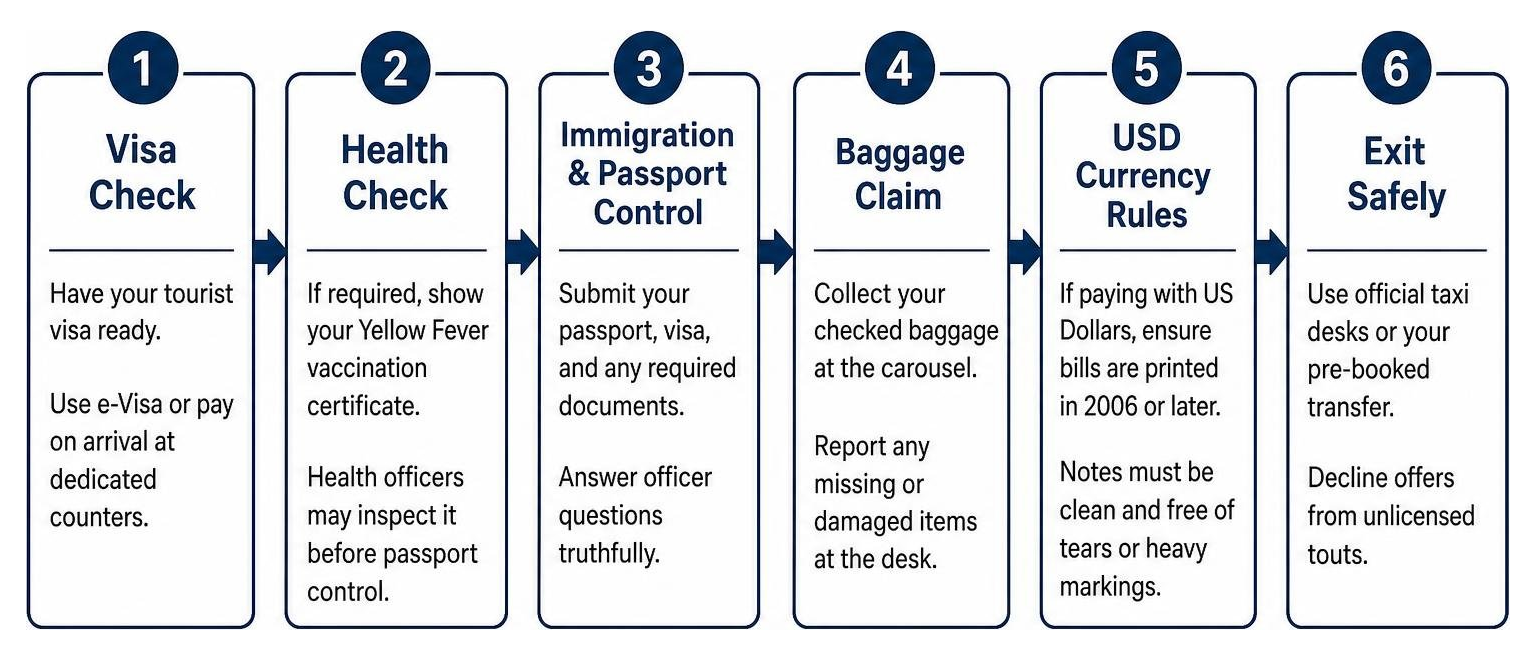
To clear immigration at JRO without unexpected delays, keep these operational rules in mind:
- Entry Visas: Most international visitors require a tourist visa to enter Tanzania ($50 USD for most foreign nationals; $100 USD for US citizens). You can apply for a Tanzania e-Visa online prior to departure or purchase a Visa on Arrival using cash or card at dedicated counters in the JRO arrivals hall.
- Yellow Fever Vaccination: A Yellow Fever vaccination certificate is mandatory if you are arriving from or transiting for more than 12 hours through a country with risk of Yellow Fever transmission (such as Kenya or Ethiopia). Airport health officers inspect yellow immunization cards before you proceed to passport control.
- Crucial USD Currency Rules: If you plan to pay for fees or transfers using US Dollars, all USD banknotes must be printed in 2006 or later. Tanzanian banks, exchange bureaus, and drivers strictly reject US Dollar bills printed before 2006 due to historical counterfeiting concerns. Bills must also be free of severe tears or heavy markings.
Common Pitfalls and Scams Outside JRO Terminal
While Tanzania is a welcoming destination, international airports everywhere attract opportunists targeting newly arrived tourists. Protecting yourself requires keeping a few simple guidelines in mind:
- Unlicensed Touts: Refuse transportation offers from unbadged individuals soliciting rides inside the baggage hall or parking lot. Always use a pre-booked driver or approach the official airport taxi desk.
- Overcharging on Unmetered Rides: Taxis at JRO do not utilize digital meters. Always negotiate and fix the exact total vehicle price in writing or clear verbal agreement before putting your luggage into the trunk.
- Late-Night Arrival Accommodations: Sleeping inside JRO terminal overnight is strictly prohibited by airport security. If your flight arrives between 1:00 AM and 4:00 AM, ensure you have pre-booked hotel accommodation for that night, as well as a pre-arranged transfer driver waiting to transport you safely.
- Driver Verification: When meeting a pre-booked transfer, verify that the driver knows your full name and company booking details before getting into the car. For additional security advice, review our guide on Kilimanjaro Airport Transfer Services for Safari Travelers.
Sightseeing and Safari Connections Near JRO
If you have a spare day before your mountain trek begins or a flight departing late in the evening, you can integrate local sightseeing directly into your airport transfer itinerary.
Combining Your Airport to Kilimanjaro Journey with Local Attractions
Several iconic locations sit just a short drive from the JRO highway:
- Serval Wildlife: Located approximately 35 km from JRO, this eco-tourism sanctuary offers close-up interactions with rescued wildlife, including giraffes, ostriches, elands, and serval cats. Combining your airport pickup with a detour to Serval Wildlife is an excellent way to launch your trip. Discover more about this connection in our article on traveling from Kilimanjaro Airport to Serval Wildlife.
- Kikuletwa (Chemka) Hot Springs: Situated near Boma Ng’ombe between JRO and Moshi, Chemka is a natural geothermal oasis surrounded by fig trees. The crystal-clear turquoise waters reach depths over 6 meters, offering a refreshing swim to shake off long-haul jet lag.
- Arusha National Park & Momella Lakes: Located under an hour’s drive from JRO, Arusha National Park features Mount Meru, black-and-white colobus monkeys, and flamingo-filled crater lakes—ideal for a full-day warm-up safari before starting a Mount Kilimanjaro trek.
Frequently Asked Questions About JRO Airport Transfers
How far is Kilimanjaro International Airport from Moshi and Arusha?
JRO is located roughly 40 to 42 kilometers (25 miles) west of Moshi town, which takes about 30 to 50 minutes by road. Arusha is located approximately 50 to 53 kilometers (31 to 33 miles) west of JRO, requiring about 60 to 70 minutes under standard traffic conditions.
What is the average cost of transport from JRO?
A pre-booked private sedan or SUV transfer costs between $40 and $50 USD to Moshi, and between $50 and $80 USD to Arusha. Shared shuttle bus seats cost roughly $10 to $15 USD (10,000 to 35,000 TZS) per person. Cash payments in post-2006 USD or Tanzanian Shillings are widely accepted by local drivers.
Is it better to book a private transfer in advance or get a taxi upon arrival?
Pre-booking a private transfer is strongly recommended, especially if you are arriving at night, traveling with children, carrying heavy high-altitude trekking gear, or arriving in a group. Pre-booked services guarantee fixed transparent pricing, personalized terminal meet-and-greet service, flight tracking, and dedicated child seat availability.
Conclusion
Getting smoothly from the airport to kilimanjaro sets a relaxed, confident tone for your entire Tanzanian journey. Whether you are flying into JRO via direct long-haul international flights or connecting through regional hubs like Nairobi or Dar es Salaam, planning your ground transfer in advance saves time, eliminates stress, and ensures your safety.
At Safari Cabs Kilimanjaro, we specialize in reliable, comfortable, and prompt airport transfer services tailored to mountain climbers and safari travelers. From single-passenger sedans to spacious group minivans equipped for heavy climbing duffels, our professional drivers monitor your flight arrival time and meet you as soon as you clear customs.
Ready to start your adventure without travel friction? Reserve your safe airport ride today by visiting our Kilimanjaro Airport to Arusha transfer page!