
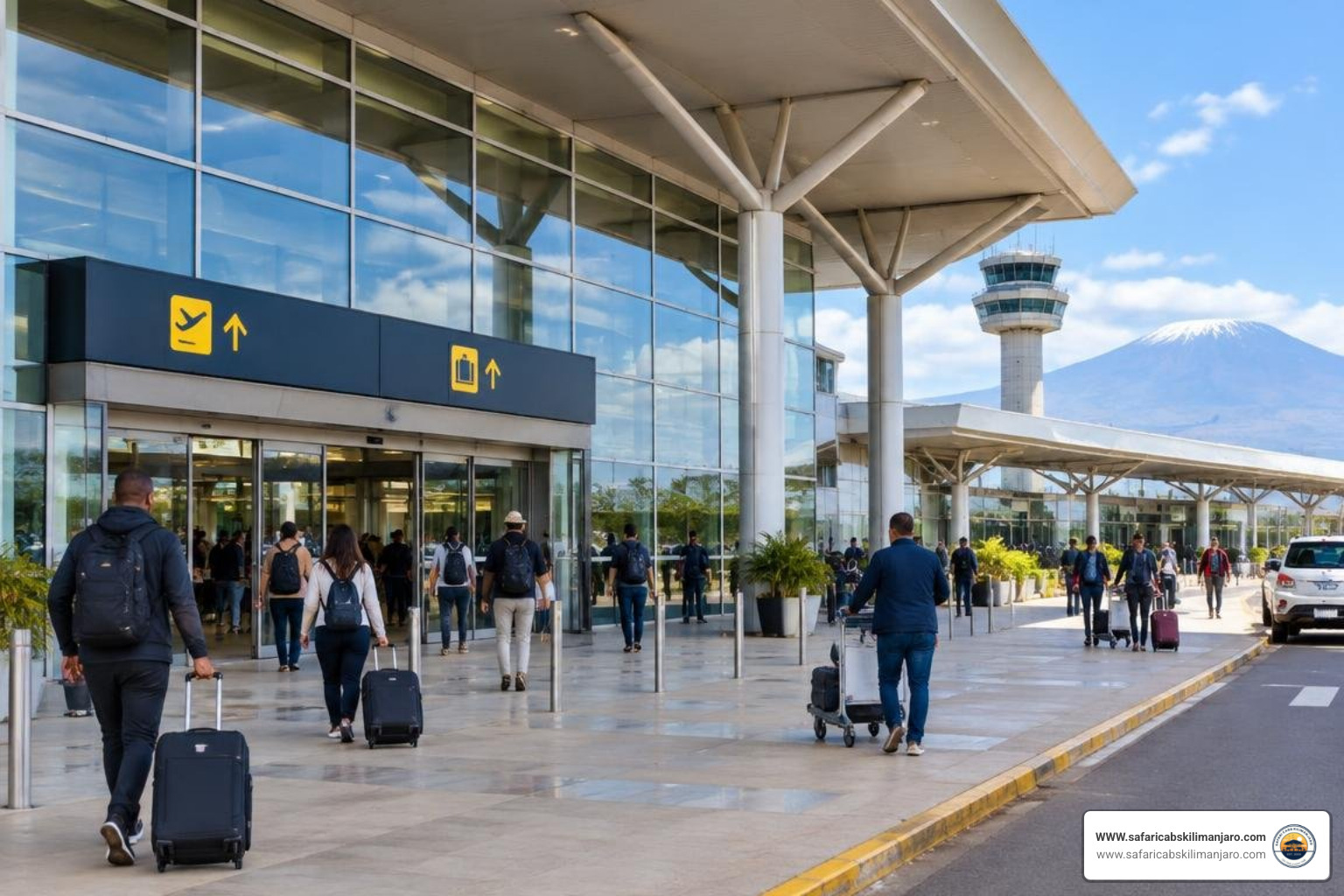
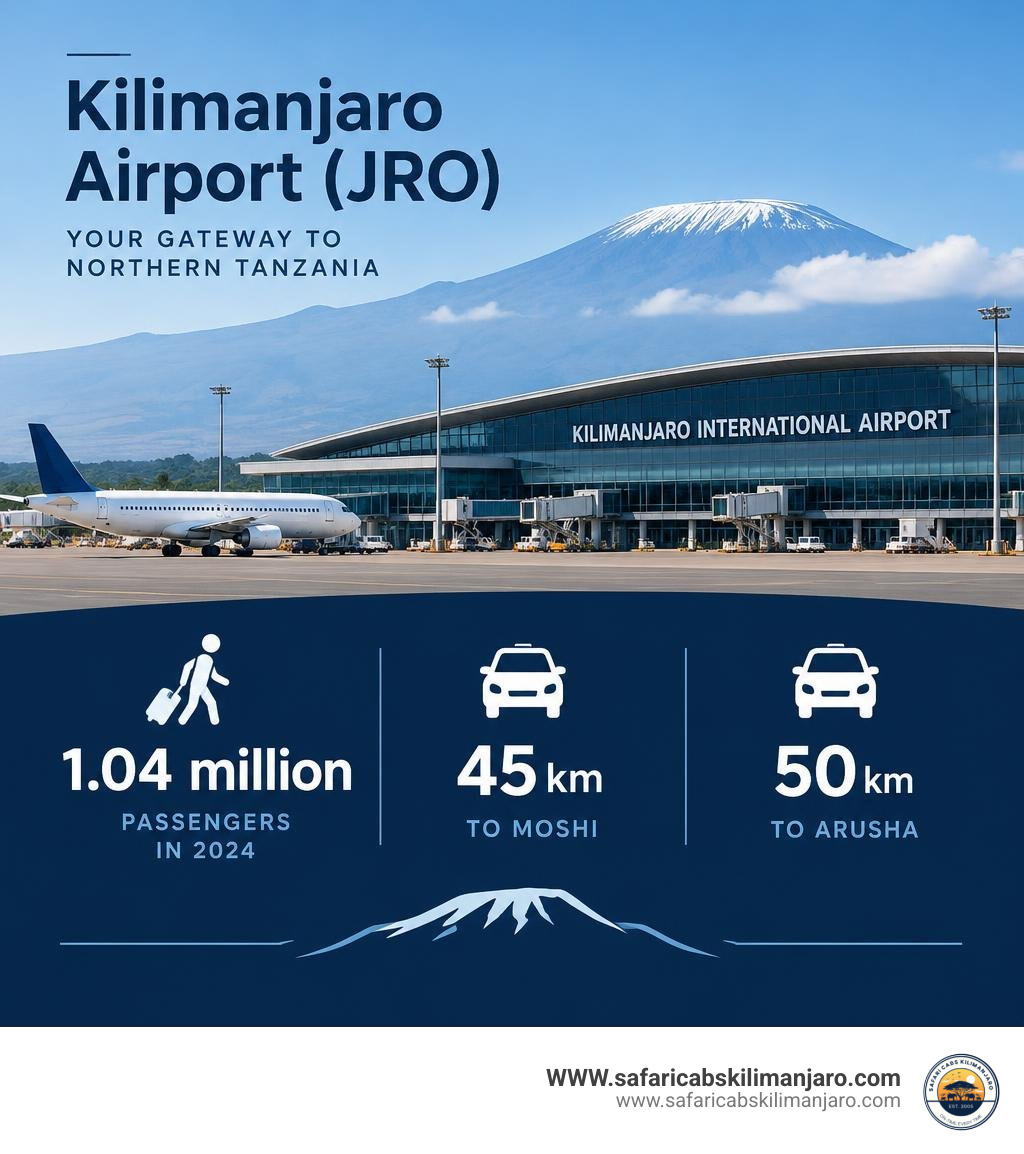
Kilimanjaro International Airport (JRO) is the main airport for travelers climbing Mount Kilimanjaro or visiting Tanzania’s northern safari parks. It sits between Moshi and Arusha. Plan on about 45-60 minutes to Moshi or 60-75 minutes to Arusha by road, and book your transfer before you land.
JRO handled just over 1 million passengers in 2024. It serves international and domestic flights, making it a practical starting point for trips to the Serengeti, Ngorongoro, Tarangire, and Lake Manyara.
Overview and Technical Profile of Kilimanjaro Airport JRO
Kilimanjaro International Airport is a modern, high-capacity aviation hub engineered to handle large long-haul aircraft and steady tourist traffic. The facility features a single asphalt runway (09/27) measuring 3,600 meters (11,811 feet) in length and 45 meters in width. This generous runway length allows wide-body jetliners, such as the Boeing 747, Boeing 777, and heavy freighters like the Antonov 124, to take off and land safely with full passenger and fuel loads.
Navigational reliability is supported by a Category II Instrument Landing System (ILS). This technology enables precision approaches even when low cloud cover or seasonal mountain mist reduces runway visual range to as low as 300 meters. Ground safety operations are maintained by an on-site emergency team rated at ICAO Category 9, operating heavy fire engines capable of discharging 10,000 liters of water and foam at high pressure within seconds.
Beyond passenger travel, the airport operates a dedicated 8,000-square-meter dry cargo terminal with an annual capacity of 25,000 tons. This terminal plays a vital role in regional trade, enabling local producers to export fresh flowers, vegetables, and specialty Kilimanjaro coffee directly to European markets. For broader logistical data and historical records, researchers often review comprehensive research on Kilimanjaro International Airport.
History, Ownership, and Upgrades
The airport opened its doors on 2 December 1971. Its original construction was financed through a US$13 million loan from the Italian government, designed to give Tanzania an independent international gateway dedicated to wildlife tourism.
In 1998, JRO made aviation history by becoming the first international airport in Africa to be privatized under a long-term concession managed by the Kilimanjaro Airport Development Company (KADCO). Today, the facility operates under the direct oversight of the Tanzania Airports Authority (TAA).
Between 2015 and 2017, the terminal underwent a comprehensive multi-million-dollar modernization project that doubled its annual passenger handling capacity from 600,000 to 1.2 million travelers. To accommodate ongoing tourism growth across East Africa, further infrastructure improvements—including runway resurfacing, apron expansions, and upgraded airfield lighting—are underway to scale capacity toward 1.5 million passengers by 2030. You can explore additional historical milestones via this historical overview of Kilimanjaro International Airport.
Location and Specifications of Kilimanjaro Airport JRO
Geographically, the airfield sits in the Hai District of the Kilimanjaro Region, at an elevation of 2,932 feet (894 meters) above mean sea level. This moderate elevation offers pleasant, temperate weather for landing aircraft and arriving passengers alike.
The airport is positioned directly along the smooth A23 highway corridor, situated approximately 40 kilometers east-southeast of Arusha and 30 kilometers west-southwest of the snow-capped peak of Mount Kilimanjaro. Detailed coordinates, radio frequencies, and runway technicalities can be explored in our HTKJ operational and technical specifications.
Airlines, Destinations, and Terminal Passenger Services

Whether you are arriving on an overnight flight from Europe or stepping off a domestic hop from the coast, the airport terminal provides a welcoming, straightforward layout. Passenger safety remains paramount, backed by rigorous baggage screening, multi-layer aviation security, and continuous patrols. You can review all current safety protocols and airport security at JRO to plan your transit with total peace of mind.
Inside the terminal, travelers have access to essential utilities, including automated teller machines (ATMs) dispensing local Tanzanian Shillings (TZS), authorized foreign exchange bureaus, and mobile provider kiosks offering tourist SIM cards with data packages. Complimentary wireless internet is available throughout the main concourse via the open “Kia Hotspot” network. A 24-hour medical clinic is situated within the building, staffed to handle emergency first aid and provide mandatory health clearances, including yellow fever vaccinations for eligible travelers ($50 USD fee).
International and Domestic Flight Routes
JRO connects northern Tanzania to major global transit hubs across Europe, the Middle East, and Africa. Several full-service international carriers maintain scheduled daily or multi-weekly frequencies:
- KLM Royal Dutch Airlines: Direct long-haul flights linking Amsterdam Schiphol (AMS) to JRO.
- Qatar Airways: Scheduled services connecting through Hamad International Airport (DOH) in Doha.
- Turkish Airlines: Regular flights via Istanbul Airport (IST).
- Ethiopian Airlines: Seamless connections across Africa and North America via Addis Ababa (ADD).
- Kenya Airways: Daily regional shuttles connecting Nairobi Jomo Kenyatta (NBO) to Kilimanjaro.
- Air Tanzania & Precision Air: Extensive scheduled domestic networks reaching Dar es Salaam, Zanzibar, Entebbe, and regional bush strips.
You can monitor real-time schedules and flight statuses using live flight tracking and route data for JRO.
Terminal Facilities, Lounges, and Duty-Free
The departure concourse features comfortable seating areas alongside retail shops showcasing authentic Tanzanian heritage. Visitors can purchase world-famous blue Tanzanite gemstones certified by registered jewelers, single-origin Arabica coffee grown in the volcanic foothills of Mount Kilimanjaro, and hand-carved Makonde woodwork.
Before boarding, travelers can relax in the upper-level business lounge, grab hot meals at the terminal restaurant, or browse duty-free selections of premium spirits and perfumes. For detailed shopping advice, explore our Kilimanjaro airport duty-free shopping guide.
If your flight arrives late in the evening or departs at dawn, staying close to the runway eliminates highway travel stress. Discover convenient lodges with shuttle access through our guide on nearby accommodations and transit lodges.
Ground Transportation and Safari Circuit Connectivity
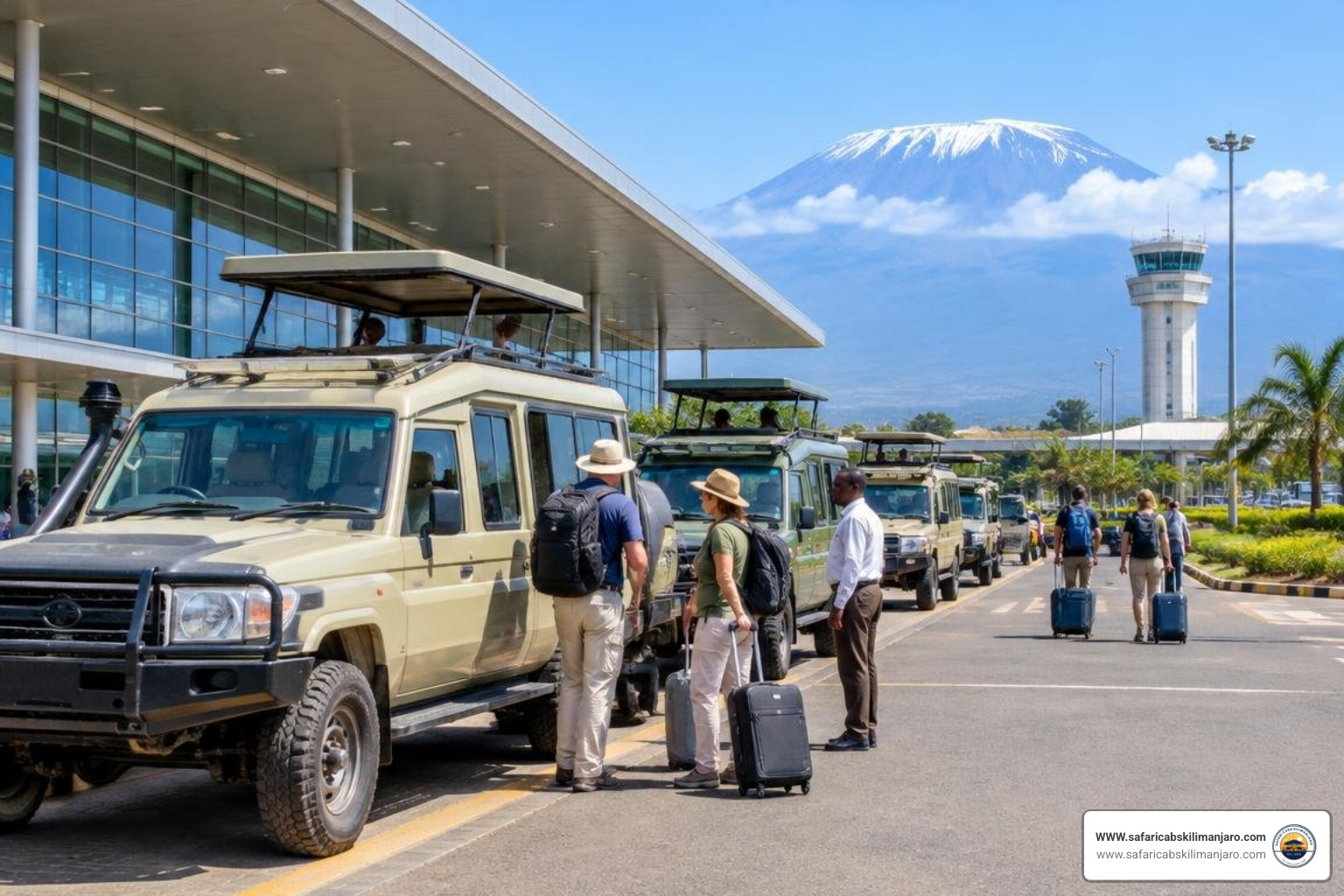
For wildlife enthusiasts and trekking groups, Kilimanjaro International Airport is the premier springboard for world-renowned destinations, including the Serengeti National Park, Ngorongoro Conservation Area, Tarangire National Park, and Mount Meru. Learn how to optimize your safari transit in our guide to planning your northern circuit safari from JRO.
Transfers to Arusha and Moshi
Because JRO is situated in an open plain between major urban hubs, you will need ground transport to reach your base lodge:
- Moshi (Mount Kilimanjaro Treks): Approximately 45 kilometers (28 miles) east via the A23 highway. The transfer takes 45 to 60 minutes in normal traffic conditions.
- Arusha (Safari Capital): Approximately 50 kilometers (31 miles) west via the A23 highway. The transfer takes 60 to 75 minutes, depending on urban traffic closer to the city center.
Booking a private, licensed vehicle in advance protects you from inflated on-the-spot pricing and long curbside negotiations. Browse our reliable taxi services from Kilimanjaro Airport and inspect our transparent overview of official taxi pricing and transfer rates to budget accurately.
Navigating Kilimanjaro Airport JRO vs. Arusha Airport (ARK)
Many visitors wonder whether they should land at JRO or Arusha Airport (ARK). While both serve northern Tanzania, their operational roles are distinct:
| Feature | Kilimanjaro International Airport (JRO) | Arusha Airport (ARK) |
|---|---|---|
| Location | 50 km east of Arusha (Hai District) | 7 km west of Arusha city center |
| Airport Classification | Full International Gateway | Small Regional Domestic Field |
| Runway Specs | 3,600 m asphalt (Wide-body jets) | 1,620 m asphalt (Turboprops & bush planes) |
| Airlines Served | KLM, Qatar, Ethiopian, Turkish, Air Tanzania | Auric Air, Coastal Aviation, Flightlink |
| Customs & Immigration | Full international border control facilities | Domestic only (No international clearances) |
| Best Suited For | International arrivals, Kilimanjaro climbs | Direct bush hops into Serengeti / Lake Manyara |

Essential Arrival, Visa, and Departure Procedures
Arriving smoothly at JRO requires understanding the step-by-step entry protocol:
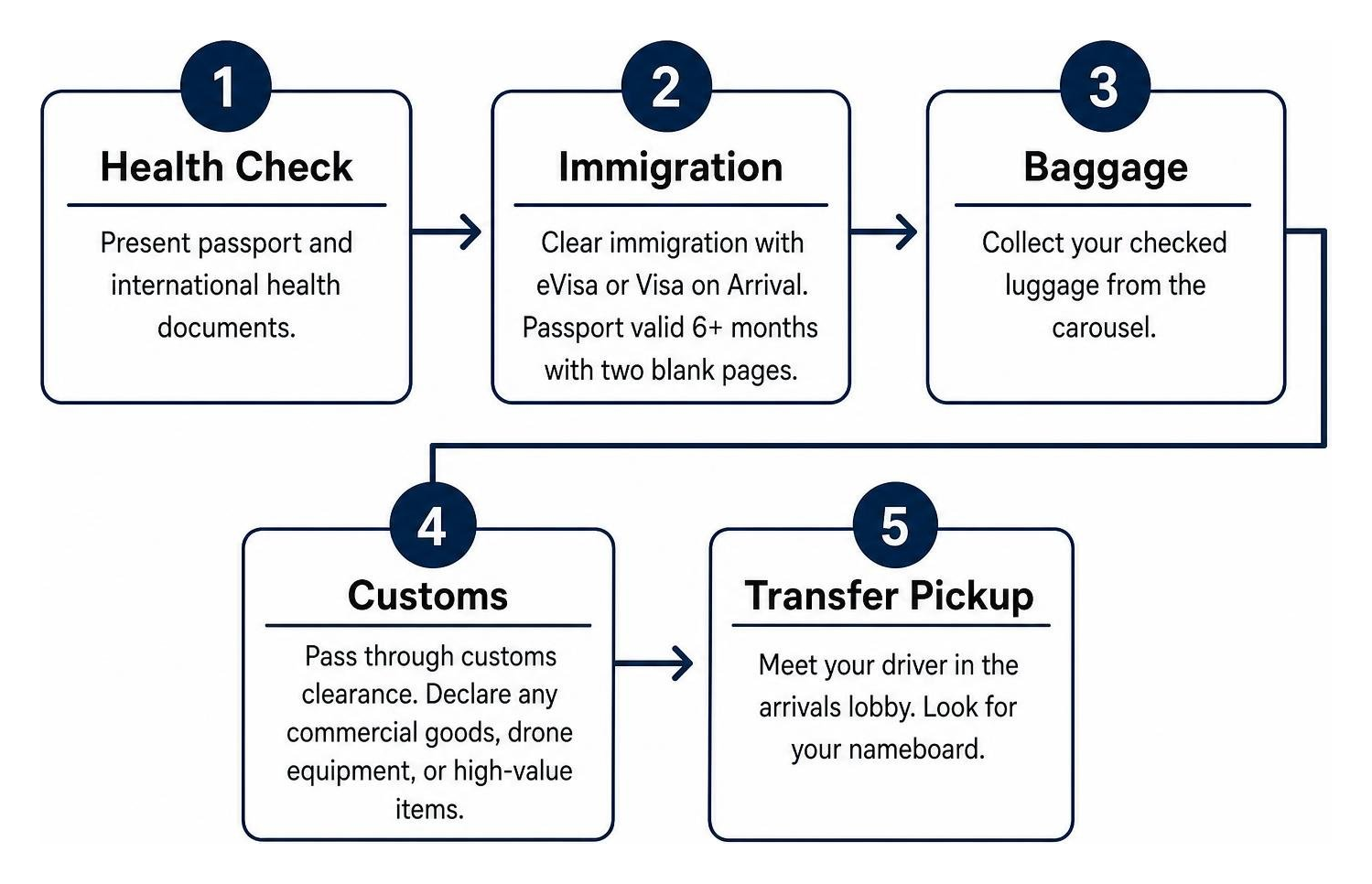
- Port Health Check: Present your passport and international health documents (such as yellow fever cards if arriving from endemic transit zones).
- Immigration Clearance: Join the appropriate queue for either pre-approved electronic visas (eVisa) or Visa on Arrival (VoA). Ensure your passport holds at least 6 months of validity and two blank pages.
- Baggage Claim: Collect your checked luggage from the carousel in the primary reclaim hall.
- Customs Inspection: Pass through customs clearance. Declare any commercial goods, drone equipment, or high-value items.
- Driver Meet-and-Greet: Step into the arrivals lobby where licensed transfer drivers hold personalized nameboards.
For departure journeys, international airlines require check-in clearance 2.5 to 3 hours prior to takeoff. When planning your airport journey, follow our simple guide on how to pre-book trusted airport transfers.
Essential International Departure Checklist
- Confirm all departure baggage weights comply with your international airline’s allowance.
- Keep your digital flight ticket and valid passport accessible for outer security checkpoints.
- Re-pack raw Tanzanite gemstones with official government export receipts and certificates.
- Pack spare lithium batteries and camera power banks in your carry-on luggage, not in checked bags.
- Allow extra travel time along the A23 highway if departing during Friday afternoon rush hours.
Frequently Asked Questions About Kilimanjaro Airport
What international airlines operate scheduled flights to JRO?
JRO hosts premier global airlines, including KLM Royal Dutch Airlines, Qatar Airways, Turkish Airlines, Ethiopian Airlines, and Kenya Airways, alongside regional charter carriers and Air Tanzania.
How long does it take to travel from JRO to Arusha or Moshi?
Driving along the tarmac A23 highway takes approximately 45 to 60 minutes to reach Moshi (45 km) and roughly 60 to 75 minutes to reach central Arusha (50 km). You can easily arrange a vehicle by arranging licensed taxis at the arrival terminal.
Can international travelers get a Tanzania visa on arrival at JRO?
Yes, eligible tourists can obtain a Visa on Arrival directly at the JRO immigration hall. The standard fee is $50 USD for most international passport holders, and $100 USD for US citizens (payable in clean, unmarked USD cash or credit card). Applying online via the official Tanzania eVisa system before departure is recommended to reduce terminal wait times.
Conclusion
Kilimanjaro International Airport is the undisputed gateway to Africa’s highest peak and the world’s most spectacular wildlife reserves. Understanding the airport layout, flight options, and border clearance procedures ensures your journey begins without delays.
Let us take the stress out of your Tanzanian arrival with private, air-conditioned 4×4 vehicles and professional drivers waiting at the arrivals gate. Ready to begin your safari adventure? Simply book your private Kilimanjaro airport transfer today!